You become a creditor of the company or state, which promises to return the money plus interest within a certain period. Therefore, you assume the issuer's credit risk; in other words, the risk that the debtor will not be able to pay its debt ("default").
The interest payment is received in the form of a recurring coupon and, finally, the principal is returned. Unlike the dividends when investing in shares, coupon payments do not change depending on the profits generated by the company – they are a fixed amount that is known at the time of issue (hence the name "fixed income"). Bond investors must analyse the company's ability to repay the debt before it looks at its growth or the profits it generates. Obviously, the better the business evolves and the higher the profits, the greater the company's ability to pay. Fixed income investors do not benefit directly from this, although they do have greater security regarding the debtor's solvency and, therefore, the probability of the debt being repaid.
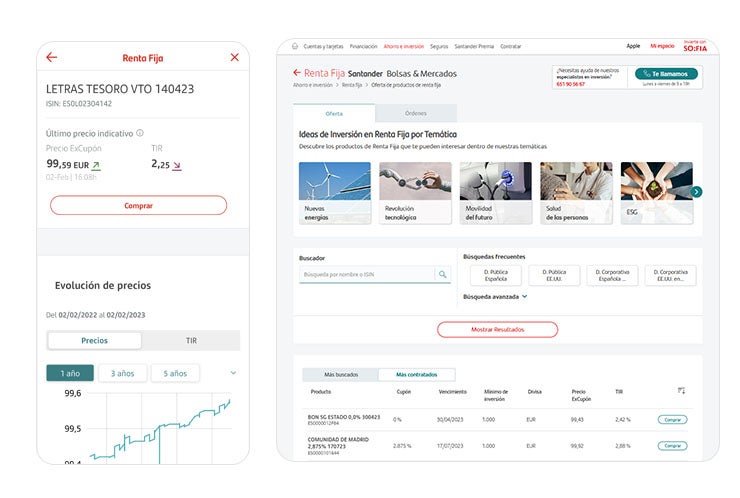
The fluctuation risk is assumed in the bond price. Like shares, the market constantly values bonds. Their price is therefore not fixed and if you decide to quit your investment before the bond matures, you assume the market risk – namely, . the variation in the bond price. At all times, the market requires a return in order to become a creditor: this is the "IRR" (Internal Rate of Return). Although the coupon is fixed, investors can achieve a lower or higher return by buying the bond above or below the issue price, respectively. Therefore, changes in the IRR will cause variations in the bond price. Although this only affects you if you sell the bond before maturity.

 Spanish
 Catalan
 English